Things Had It Coming
When she isn’t pretending to be a dragon, my seven-year-old pretends to be a cat. “Mrrrowrrr,” she says when she pounces on me in bed in the morning. “Raawwwrrr,” she purrs when it’s time for her to line up for second grade. “Grrrrrr,” she rumbles at bedtime, her bones suddenly transforming to jelly. If certain “news” articles were to be believed, we’d have a litter box in the bathroom.
So, as a surprise, I picked up Cats Knocking Things Off Ledges. Designed by Sen-Foong Lim and David Killing, it’s as descriptive a game as they come. My seven-year-old treats it as a tornado simulator.
Bewitchments, Buckets, Bugs
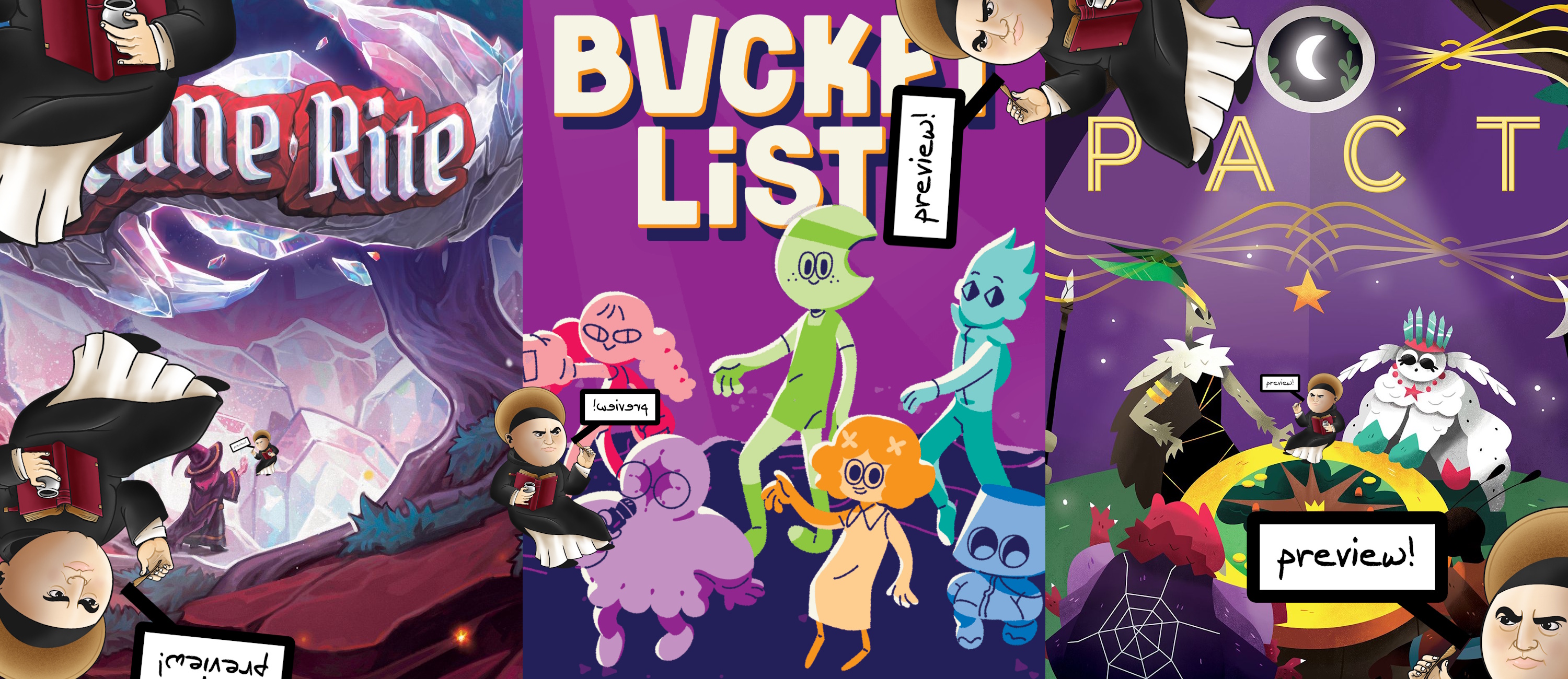
Imagine me in a real pickle sandwich. The middle of preview season (ho ho ho), and suddenly I come down with not one illness, but two. Something chronic, something acute. And me with a whole stack of board games to write about. Some of them time-sensitive, counting down the minutes on crowdfunding platforms as we speak.
What’s an old man to do? Write about all three in a single splash, naturally.
In other words, here are three very different tabletop titles, each worth a wink of your time. Come on in. Let me tell you about them. Briskly, before I’m back to bed.
Given the Land If They Lived Righteously

I’ve never been to Machu Picchu, but it was the site that demonstrated to me at an uncomfortably young age that history wasn’t just one thing but many, and that those many things were subject to a wide range of interpretations. Even, possibly, that they might end friendships.
Which is appropriate, because that’s exactly what Wiñay Kawsay, designed by Alison Collins, is all about.
Cumulostratic Cruise
On not-so-rare occasions, I get to play board games before they’re fully polished. There’s something about seeing a game struggle through its growing pains, watching its knobbly limbs grow lithe and athletic, its protrusions smooth and frictionless, that recalls editing a novel for publication or appraising frames for the final cut. Most of the time, this process is a hard one. “Murder your darlings,” Sir Arthur Quiller-Couch said of an author’s finest phrases. Cut them down to size. That’s what it takes to make something great.
Only I’m not convinced we don’t sometimes murder a little too liberally. Sometimes I’ll play a finished game only to discover that the essential soul that made its earlier incarnation worth experiencing has been killed along with the wobbly iconography and degenerative action states. Somewhere in the process, development has sanded down the knobs and protrusions — and left little more than a burnished stick. Good for a walk, perhaps, but not especially notable.
Which brings us to Braided Skies, created by Dan Germain and Stonemaier Games.
A Place for All My Fussy Guests
It’s almost too obvious to state aloud, but there’s a lot to be said for the games we actually play. Case in point, Enchanted Ivy, the solitaire game by Sarah Joshua. When I sat down this morning to begin writing this review, I went through the usual steps. Picking and editing the images. Uploading the template and arranging everything into logical order. Glancing through a few notes.
But then I thought to myself, maybe I don’t understand this game yet. Even though I’ve played it well over thirty times. One more session. In endless mode with randomized guests. Just one extra play to make sure I know what I’m talking about.
And then, with such inevitability that I’m not sure why I ever thought differently, I played it twice. That’s Enchanted Ivy for you.
Tantrums in the Sandbox
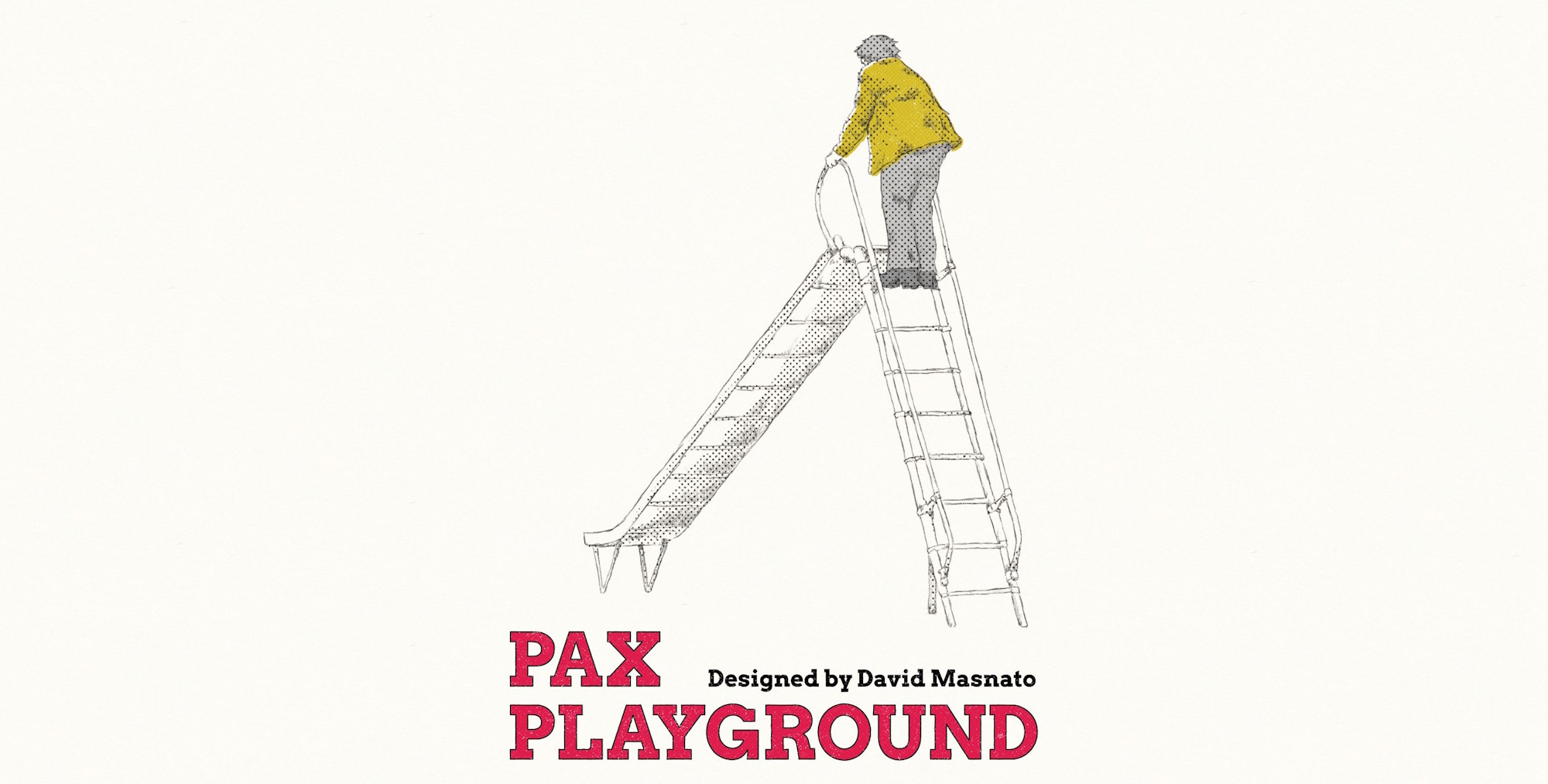
Of the handful of things I appreciate about Pax Playground, the most significant is the way it reminds me of recess. Its very existence is playful — this is, after all, a Pax game that lasts twenty minutes and bucks tradition by refusing to touch history with a ten-foot pole, let alone compose loopy footnotes about it.
More importantly, David Masnato, who previously did the art for Matilda Simonsson’s Turncoats and Pax Penning, uses Pax Playground to reproduce the anxieties of childhood. Like a child, you step into the game buoyed by possibility — and weighted down by it. As a game about play, it’s playful; as a game about becoming yourself, it’s as fretful as a kid trying to decide which sweet to pick out at the store.
Again, Opium War, Again
When Cole Wehrle first unveiled An Infamous Traffic way back in 2016, it was a scrappy little devil. Not only was it Wehrle’s second design, it was also among the earliest releases from Hollandspiele. As such, its constraints were stark: a handful of counters and dice, a paper map, and one of the worst rulebooks ever written. (That last one was included in the contract: “The designer will include a horrible rulebook that doesn’t explain the game in the slightest.”)
Now a second edition is on the way. Much like Wehrle’s second stabs at both Pax Pamir and John Company, this is the work of a designer who knows what he wants to say. More importantly, it’s the work of a designer who’s spent the intervening decade learning how to use the curious medium of tabletop board games, simultaneously one of our ancientest and most recent arts, to paint a compelling and damning landscape of 19th-century business.
Satchel of Holding
There’s undoubted utility to a bag of holding, but I always imagine everything jumbling together like loose chicken parts. Magical tomes next to tavern dinners next to razor implements, sloshing around to produce a pulpy slurry.
Designed by Molly Johnson, Robert Melvin, and Shawn Stankewich — best known for Point Salad and Verdant, although my course of choice would be the excellent TEN — Satchel Quest might be the first game to really understand the problem. This is a bag-builder only slightly in the vein of The Quacks of Quedlinburg, featuring hints of that title’s press-your-luck gameplay, but really emphasizing the disorderly nature of a magical burlap sack where one’s potatoes are stored beside mana crystals and radioactive artifacts. For example, you’ve decided to hold not only an entire arsenal in your satchel, but also a whole bunch of monsters.
If that sounds like a bad packing decision — and I’m saying this as someone who grew up schlepping a half-dozen hardbacks on any given weekend trip — then rest assured there’s a reason for all those odds and ends.
Grabble Grabble
CMYK is on a hot streak. Get it? Hot streak? Fine, I’ll just tell you about this other board game. Grabble is a remake of Naoki Fukuda’s Nuts a GoGo!, which probably doesn’t tell you much. Imagine a bunch of people scrambling around a box for mismatched components. Shortly thereafter, they wage a sudden-death competition with their foraged traffic cones, dice, and metal pigs. In and out, five minutes.
That’s Grabble. It’s fast, it’s silly, and then it’s over. Unless you play more than once, which is more or less mandatory. Unlike a few other recent CMYK releases, I suspect this one will prove too trifling for some. I think I’ve played it something like forty times in the past month alone.
Sharts of Creation
All I play anymore is trick-taking games.
At times, that feels like an invitation to make me regret what little time I have left on this Earth.
Shards of Creation is the latest unfortunate example. Designed by Hayden Dillard, it fails to utilize the past decade of sound tabletop design principles, let alone the trick-taking revolution that has produced so many wonderful trifles. It is the anti-trick-taker, the title I would place before someone I was hoping to dissuade from getting into the hobby.


